LaTeX for engineering documentation. Why we use it.
At Feed4ward, we take a software engineer’s view of project documentation, using principles such as inheritance, templating and object reuse to produce consistent and precise documentation for our GAMP®5-compliant automation projects. To enable this, we use the typesetting package ‘LaTeX’ for engineering instead of conventional word processors. LaTeX is pronounced “Lay-tech”.
The original advanced typesetting system, TeX, developed in the 80’s for creating complex technical text layouts and displaying mathematical expressions and formulas, has a macro package known as LaTeX. Unlike word processors such as MS Word, LaTeX separates the document’s content from its formatting. You can configure styling independently and apply it consistently across documents, while the source code remains in plain text, making it platform-independent and reusable, ensuring the same output file quality every time.
How LaTeX for engineering documents works
This very simple example demonstrates how the LaTeX source code appears and what it generates.


Additional packages of commands can expand the engine that converts the LaTeX code into a printable format such as PDF. You can write common glossary and abbreviation entries in a separate file, and the main document will list them automatically when referred. A simple command creates footnotes, and the system numbers and lists section titles automatically.
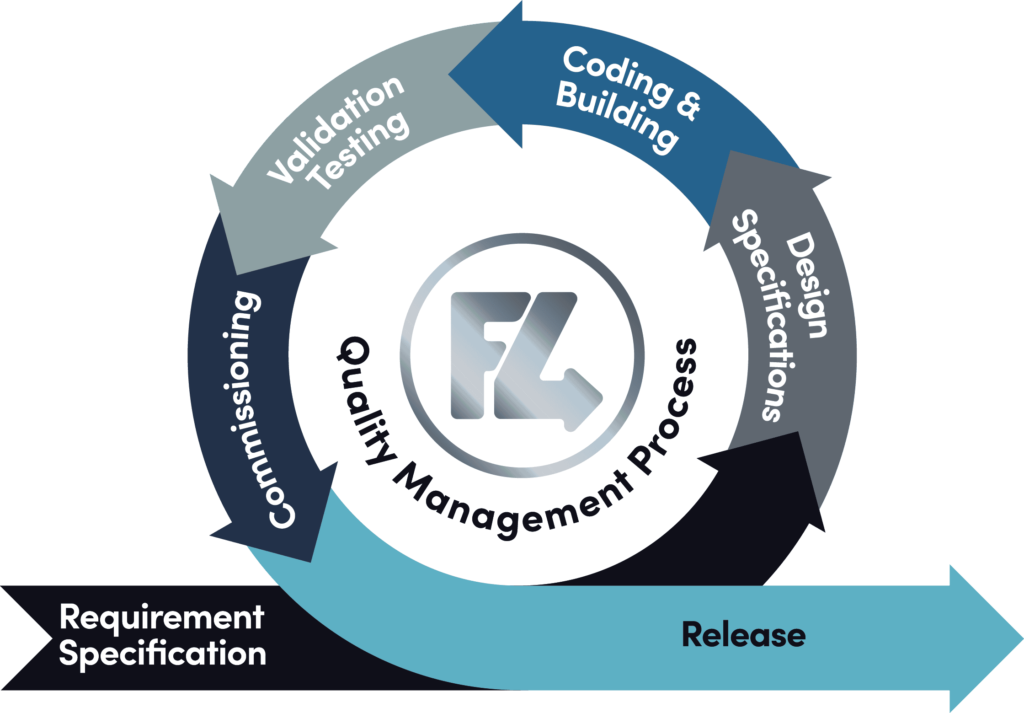
It is this flexibility and consistency that appealed to us for the implementation of our ISO9001 Quality Management System documents and for the GAMP®5 project life cycle of the software developed in-house.
Project documents all use the same layout and style template, allowing the authors to focus only on the content of the document. The result is a recognisable document format, across all the Feed4ward projects, with the high quality standards we set for ourselves.
The LaTeX plain text source code allows our automation nature to run wild. Having developed several Perl scripts that automatically generate complex documents, we can reduce the writing and formatting time required to a minimum, and better use our time for software development.
Paper-free and automated

We have recently introduced a “no-paper” policy to reduce our carbon foot-print and improve the document workflow by adopting electronic signatures. Signature fields are defined in the LaTeX source document and the final PDF output makes use of the Adobe Acrobat e-signature features. All signatures are individually authenticated and once the trusted certificate is shared, that person’s signature cannot be forged.
We have further extended our paper-free approach to our internal forms, eliminating the need to print paper and keeping all the information in the digital world where we can track and store it easily. Once again, LaTeX adaptability plays a key role in the implementation of digital forms. With the addition of embedded Java Script tools, our forms are dynamic and adjust to the situation at hand.
The above example demonstrates a section of a form reserved for the risk and impact assessment of a reported fault, or, if categorised as a change, replaces the fields with a justification for the action required.
In conclusion…
We use the LaTeX typesetting system to ‘engineer’ documents with consistent styling, writing in familiar programming language and generating a consistent output file that supports the requirements of our project documentation. Our engineers can focus on content rather than style and our customers receive well-structured, consistent and quality-assured documentation for their automation projects every time.
If you’d like to hear more about our unique approach to automation project delivery, please do get in touch, we’d love to talk to you.